
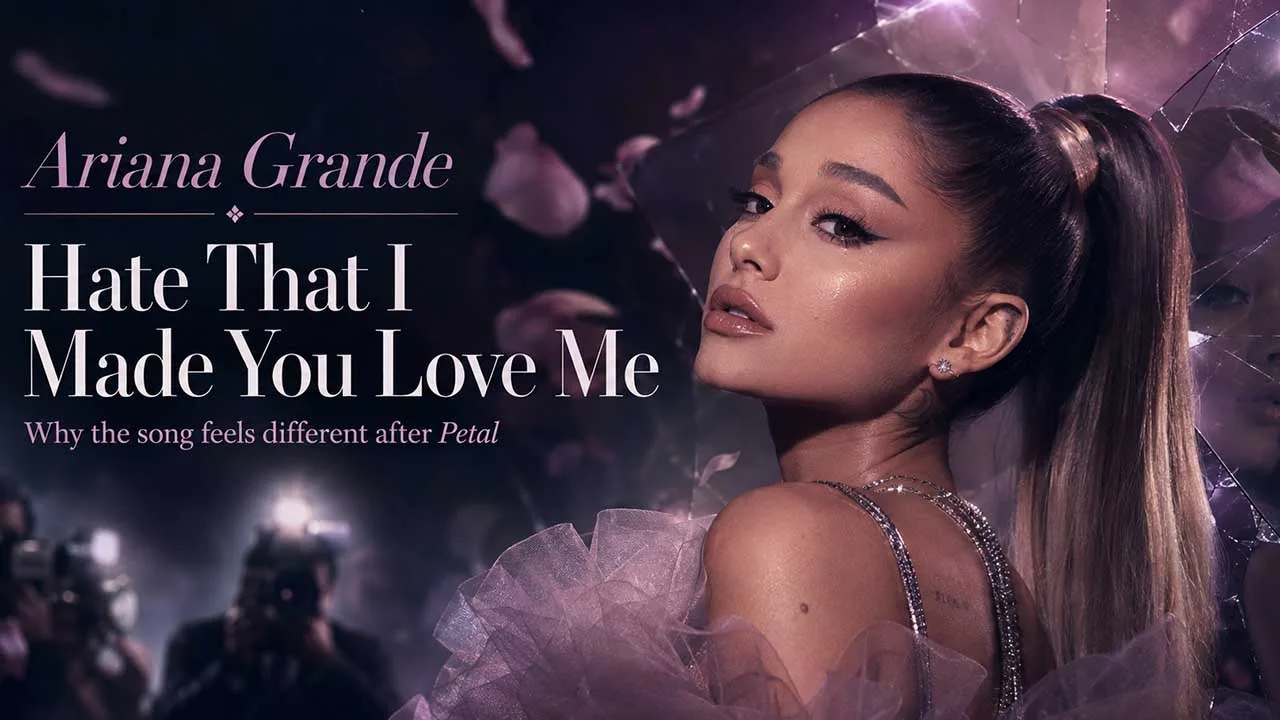
What first sounded like a beautifully cold breakup song now appears to reveal something larger: Ariana Grande’s uneasy relationship with love, attention and the people who believe they know her.
When Ariana Grande released “Hate That I Made You Love Me” on May 29, the song arrived dressed like a breakup confession.
Its central idea was sharp enough to feel almost cruel: one person became deeply attached while the other was barely trying. Grande did not portray herself as heartbroken or abandoned. Instead, she sounded painfully aware of the emotional damage left behind when affection is offered without equal intention.
Two months later, however, the song no longer feels quite that simple.
With Grande’s eighth studio album, Petal, now available in full, “Hate That I Made You Love Me” sits inside a much wider story about intimacy, fame, self-protection and the exhausting experience of being interpreted by millions of strangers. What once sounded like a message to one former lover can now be heard as a message to an entire audience.
A Love Song Without the Usual Innocence
Grande has described “Hate That I Made You Love Me” as one of her favourite songs she has ever written. Created with longtime collaborators Ilya Salmanzadeh and Max Martin, the track avoids the dramatic vocal explosions commonly associated with her biggest pop records. Instead, it moves through soft electronic textures, restrained singing and an almost unnervingly calm delivery.
That restraint is important.
Grande does not sound like someone begging to be understood. She sounds like someone who has already accepted that understanding may be impossible.
The song recognises a difficult truth about attraction: people do not always fall in love with the person standing in front of them. Sometimes they fall in love with the version they have constructed—the voice, the image, the mystery or the feeling that person created inside them.
In that reading, the title is not simply an apology. It is also a boundary.
She is sorry that the attachment happened, but she refuses to carry complete responsibility for everything another person imagined.
Petal Changes the Target of the Song
Placed within Petal, the single begins to resemble more than a traditional relationship record.
Reviews of the album have repeatedly noted its interest in fame, obsessive attention, public judgement and Grande’s need to protect herself from people who feel emotionally entitled to her. The project uses romantic language to explore both private relationships and the much stranger bond between a celebrity and the public watching her.
That context makes “Hate That I Made You Love Me” far more unsettling.
The unnamed “you” could still be an ex-partner. But it could also represent a fan who became possessive, a critic who converted fascination into resentment, or an audience that fell in love with an earlier version of Ariana Grande and now expects her to remain that person forever.
Celebrity culture often presents admiration as harmless. Yet intense admiration can quickly become a form of ownership. Fans praise an artist for being authentic, then become angry when that artist makes a decision that does not match the personality they had imagined.
Grande appears to understand that contradiction extremely well.
She helped create the image. She sang the songs, shared pieces of herself and invited listeners into carefully constructed emotional worlds. But an invitation into the music was never permission to control the person making it.
Seen this way, “Hate That I Made You Love Me” becomes less about romantic guilt and more about the cost of being desirable to people who cannot truly know you.
The Music Video Makes the Story Darker
The Christian Breslauer-directed video pushes that idea into dark comedy.
Actor Justin Long plays a man apparently attempting to bury Grande, only for her presence to follow him beyond the grave. She reappears in his car and on the road, eventually haunting him through a fiery crash. The visual reverses the usual victim-and-villain structure: the woman believed to have been removed refuses to disappear, while the man attempting to escape her becomes trapped by the very obsession he tried to destroy.
It is exaggerated, stylish and deliberately absurd, but its emotional logic matches the song.
Once someone has turned another person into an obsession, removing the real individual does not necessarily remove the fantasy. The imagined version survives. It follows them, argues with them and remains alive inside the story they have created.
Grande’s character therefore feels less like a literal ghost and more like the memory of a woman who has been reduced to an idea.
The video’s violence is playful rather than realistic, but beneath it lies a recognisable frustration: people often become most attached to someone after that person has withdrawn.
A Quiet Song That Produced Enormous Numbers
The record’s subdued sound did not prevent it from becoming a major commercial event.
“Hate That I Made You Love Me” debuted at No. 1 on the Billboard Hot 100, becoming Grande’s tenth chart-topper in the United States. It also opened at No. 1 on both Billboard global charts and gave her an eighth No. 1 single in the United Kingdom. Billboard reported 23.6 million official US streams during its opening chart week.
Those achievements create an interesting contradiction.
The song questions the emotional consequences of attracting too much attention, and the public responded by giving it even more attention.
Its success may partly come from that tension. The track is polished enough to function as mainstream pop, but emotionally ambiguous enough to invite endless interpretation. It gives listeners a memorable chorus without fully identifying who Grande is addressing or what exactly happened.
That empty space allows almost anyone to enter the story.
Some hear an avoidant lover admitting that she encouraged feelings she could not return. Others hear a woman reclaiming control after being idealised. Within Petal, a third interpretation becomes possible: a global celebrity speaking to the audience that helped create her, adore her and occasionally punish her for changing.
The Most Revealing Word Is “Made”
The title’s most interesting word may not be “hate” or even “love.”
It is “made.”
To say “I made you love me” suggests performance. It implies that love may have been produced through certain gestures, appearances or carefully chosen versions of the self. For a pop star whose career depends on building intimacy at an enormous scale, that word carries unusual weight.
Grande’s music has always made personal emotion feel close enough to touch. Her layered vocals can sound like private thoughts arriving directly through headphones. Her songs often turn pain into something elegant, melodic and easy to replay.
But manufactured closeness can still produce genuine feelings in the listener.
The artist may understand that the relationship is mediated through recordings, images and performances. The audience may understand it too. Emotion, however, does not always respect that boundary.
“I made you love me” can therefore sound both powerful and regretful. Grande knows how the illusion was built, but that does not mean she can control what people do with it.
Why the Song May Outlast Its Release Moment
Many lead singles are designed to announce an album and then gradually become inseparable from their original release campaign. “Hate That I Made You Love Me” appears capable of doing something more lasting.
Its production is understated enough to avoid feeling tied to a passing trend. Its chorus is direct, but the emotional situation remains unresolved. Most importantly, its meaning expands depending on where the listener places the word “you.”
A former lover.
An obsessed admirer.
The media.
A fan base.
Or perhaps every person who has ever fallen for a version of Ariana Grande that she no longer wishes to perform.
After hearing Petal, the song does not feel like a simple apology. It feels closer to a warning delivered in the language of romance:
You may have loved what I showed you. You may even believe that I caused that love. But the person you created from those fragments was never entirely mine—and she was never entirely real.
Review Required
Your comment may contain abusive language. If you still believe your comment is appropriate, you can submit it for admin review.